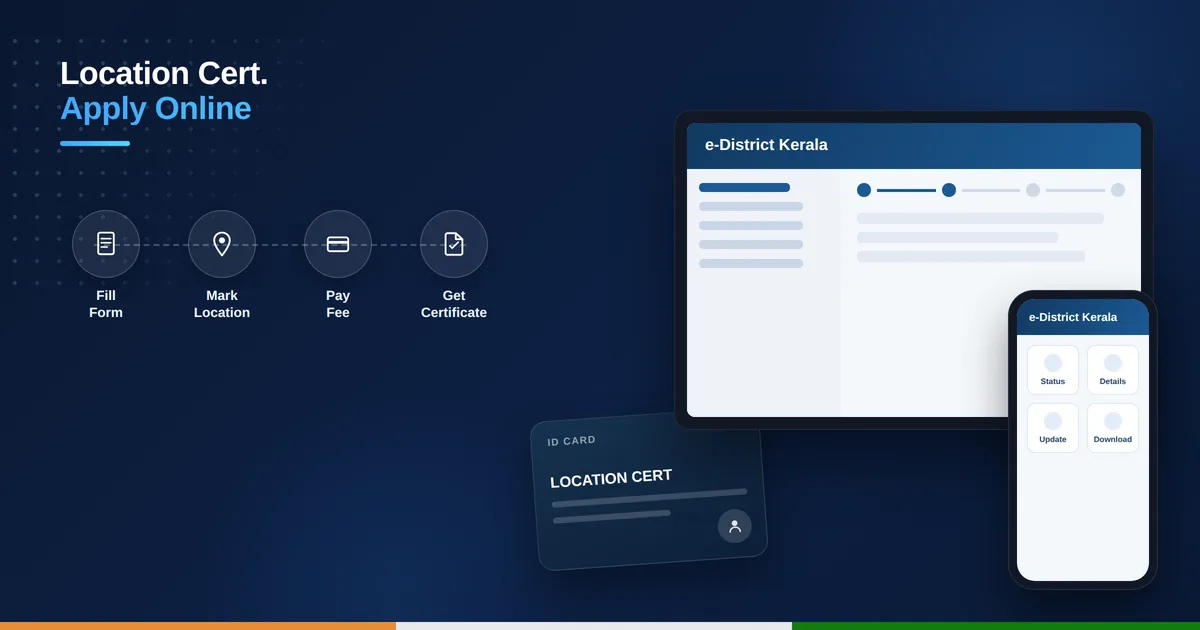
Applying for college admission, a scholarship, a government job or reservation benefits? You will likely need a caste certificate Kerala, also called a community certificate. It is issued by the Revenue Department and can be applied for online through the e-District portal or at any Akshaya centre.
This guide explains the caste certificate Kerala process in easy steps: types of certificates, who issues them, documents required, online application, verification, fees, validity and common problems.
Caste Certificate Kerala: Quick Overview
| Item | Details |
|---|---|
| Issued by | Revenue Department (Village Officer; certain categories through the Tahsildar as per rules) |
| Apply through | e-District Kerala portal, Akshaya centres |
| Common types | Community certificate, caste certificate for SC/ST, non-creamy layer certificate for OBC |
| Key documents | SSLC showing caste, parent’s certificate, ID and address proof |
| Delivery | Digitally signed certificate downloadable online |
Types of Certificates
Community certificate
Confirms the community or caste of the applicant. It is used for admissions, scholarships and applications where community details are required.
Caste certificate for SC/ST
Required for reservation and benefits meant for Scheduled Castes and Scheduled Tribes. Verification can be stricter, and the issuing authority may differ based on purpose.
Non-creamy layer certificate
For OBC and other backward communities claiming reservation, the non-creamy layer (NCL) certificate shows that the family’s income and status are within the prescribed limits. Central and state jobs may need certificates in different formats.
Uses of Caste Certificate Kerala
- College and school admissions under reservation.
- Scholarships and fee concessions.
- Kerala PSC and central government job applications.
- Welfare schemes for specific communities.
- Nominations in reserved constituencies in local body elections.
- Housing and loan schemes for SC/ST and backward classes.
Documents Required
- SSLC certificate or school records showing caste/community.
- Caste certificate of father or mother (helpful for verification).
- Aadhaar card or other ID proof.
- Ration card or address proof.
- Self-declaration, where required.
- Income details for non-creamy layer certificates.
How to Apply for Caste Certificate Kerala Online
- Go to the official e-District Kerala portal.
- Register as a citizen using your mobile number and complete One Time Registration.
- Log in and select “Apply for Certificate”.
- Choose Caste Certificate, Community Certificate or Non-Creamy Layer Certificate as needed.
- Select district, taluk and village of permanent residence.
- Enter applicant details, parents’ details, caste/community and purpose.
- Upload SSLC, parent’s certificate, ID and address proof.
- Pay the fee online.
- Submit and note the application number.
- Track status and download the digitally signed certificate once approved.
Applying Through Akshaya
Akshaya centres help citizens apply for a caste certificate Kerala and other certificates. Bring original documents; staff will scan, upload and pay on your behalf for a small service charge. Keep the receipt with the application number to track status.
Verification
The Village Officer checks school records, family certificates and local knowledge. For SC/ST certificates, verification can be more detailed, and the Tahsildar may be the issuing authority for certain purposes. You may be asked to appear with original documents. Answer queries honestly; false claims are punishable under law.
Fees, Time and Validity
Fees are nominal and processing usually takes a few working days, depending on verification. Validity depends on purpose: community certificates are often accepted for a long period, while non-creamy layer certificates are typically valid for a specific financial year. Always check what the institution or recruiting body requires.
Central vs State Format
For central government jobs and admissions (UPSC, SSC, IITs, central universities), OBC candidates need a non-creamy layer certificate in the central format. For Kerala PSC and state admissions, the state format is used. Choose the correct format while applying to avoid rejection.
Common Problems and Solutions
| Problem | Solution |
|---|---|
| Caste not mentioned in SSLC | Provide parent’s certificate, school admission register extract or other records |
| Name mismatch across documents | Get a one and same certificate or correct records first |
| Inter-caste parents | Rules depend on community and purpose; consult the Village Officer |
| Migrated from another state | SC/ST benefits usually apply only for notified communities of that state; check rules |
| Application returned | Read the remark, upload missing documents and resubmit |
For name mismatches, see our guide on the one and same certificate Kerala.
Caste Certificate Kerala for Students
Students need a caste certificate Kerala for admissions through KEAM, Higher Secondary single window, university allotments, medical and engineering counselling and many scholarships. Apply at least a month before admission deadlines, because verification can take time during the busy season. Keep both a printed copy and a digital copy ready for uploads.
For central admissions such as NEET counselling for all-India quota or IIT JoSAA, OBC students need a central-format non-creamy layer certificate issued within the date range specified in the notification. Read the admission brochure carefully and apply for the right format.
Caste Certificate Kerala for Job Seekers
Kerala PSC asks candidates to claim reservation during application and produce a valid caste certificate Kerala or non-creamy layer certificate at the time of document verification. For central jobs through UPSC, SSC, banks or railways, the certificate must follow the central format and be issued within the dates specified in each notification. Keep certificates updated and preserve originals carefully.
SC/ST Certificates: Special Points
- Benefits apply to communities notified as SC or ST for Kerala in the Constitution orders.
- Verification may involve checking ancestry and residence.
- Some purposes require certificates issued by the Tahsildar.
- Conversion to certain religions can affect SC status as per law; ST status is based on community notification.
- Kerala Institute for Research, Training and Development Studies of SC/ST (KIRTADS) may be involved in verification in disputed cases.
Non-Creamy Layer Certificate: Key Points
- Applies to OBC/SEBC communities claiming reservation.
- Considers family income from sources other than salary and agriculture, and status of parents (such as certain government posts).
- Must be renewed as required for each financial year or as specified.
- Central and state income criteria and formats can differ.
Step-by-Step Example
Ajmal, a Plus Two student from Malappuram, needed a caste certificate Kerala and a non-creamy layer certificate for KEAM and a central university application. He applied for both on e-District through an Akshaya centre, uploading his SSLC certificate, his father’s community certificate, ration card and income details. The Village Officer verified records and issued both certificates within a week. Ajmal downloaded the PDFs, saved them in DigiLocker and uploaded them during admission.
Documents Checklist
| Purpose | Documents to keep ready |
|---|---|
| Community certificate | SSLC, Aadhaar, ration card, parent’s certificate |
| SC/ST certificate | SSLC, parent’s SC/ST certificate, residence proof, any community records |
| Non-creamy layer (state) | Community certificate or SSLC, income details, parents’ employment details |
| Non-creamy layer (central) | Same as above, in the central format required for central jobs/admissions |
How to Check Application Status
- Log in to e-District Kerala.
- Open “Application Status” or “My Applications”.
- Find your application by number.
- Check the status: submitted, under verification, approved or returned.
- Download the certificate when approved.
You will also receive SMS alerts on your registered mobile number.
Verifying a Certificate
Digitally signed certificates from e-District carry certificate numbers that institutions can verify online. This reduces fraud and speeds up admissions and job verifications. Avoid tampering with or editing PDF certificates, as this is a serious offence.
Legal Warning About False Claims
Obtaining a caste certificate Kerala using false information is a criminal offence and can lead to cancellation of admission or employment, recovery of benefits and legal action. Always provide genuine documents and correct details.
Digital Storage Tips
- Save PDF copies in DigiLocker and email.
- Name files clearly, for example “Name-Community-Certificate-2026.pdf”.
- Print a few copies for offline use.
- Note the certificate number and date of issue.
Caste Certificate Kerala for Scholarships
Many scholarships for SC, ST, OBC, OEC and minority students require a caste certificate Kerala. Examples include post-matric scholarships, e-Grantz benefits for eligible communities, and central schemes on the National Scholarship Portal. Keep your certificate and income certificate updated before the scholarship season opens. Read our guides on income and other certificates on this site to prepare all documents together.
Caste Certificate Kerala for Government Schemes
Housing assistance, self-employment loans, land allotment and special welfare programmes for SC/ST and backward communities often require proof of community. Departments such as SC Development, ST Development and Backward Classes Development, and corporations for these communities, ask for a valid caste certificate Kerala along with income and residence certificates.
Correcting Errors
If the certificate has a spelling mistake, wrong community name or other error, apply for correction through e-District or the Village Office with supporting documents. Make sure your SSLC and other records are consistent; inconsistencies are the most common cause of delays.
Migrants and Inter-State Cases
If your family moved to Kerala from another state, SC/ST benefits generally apply only to communities notified for Kerala. You may need a certificate from your original state for certain purposes. OBC lists also differ between states and the central list. Seek guidance from the Village Office or Tahsildar for your case.
Children of Inter-Caste Marriages
For children of inter-caste marriages, the community is usually determined based on applicable rules and court decisions, often following the father’s community, though special circumstances can apply. Some Kerala schemes provide benefits to children of inter-caste married couples. Read our guide on the inter-caste marriage certificate Kerala for related benefits.
Tips for a Smooth Application
- Apply well before deadlines for admissions and job applications.
- Use the same name spelling as in your SSLC certificate.
- Upload clear scans of every page required.
- Mention the correct purpose so the right format is issued.
- Keep your mobile number active for OTPs and alerts.
- Respond quickly if the Village Office asks for more documents.
- Avoid agents who promise certificates for extra money.
Role of Akshaya Centres and Village Offices
Akshaya centres are the most convenient option for people who are not comfortable with online forms. They are available in almost every panchayat and charge a fixed service fee. Village Offices handle verification and issue certificates, while Taluk Offices handle certain categories and appeals. If your application is delayed without reason, politely follow up with the Village Officer and then the Tahsildar, quoting your application number.
Keep Family Records Together
Maintain a family folder with community certificates of parents, SSLC certificates of all members, birth certificates and ration card copies. When younger members need certificates for admissions or jobs, these documents make the process faster. Digital copies in DigiLocker or cloud storage add an extra layer of safety against loss or damage during floods or relocation.
Final Thoughts
Getting your certificate is easy when your records are in order. Prepare documents early, choose the correct type and format, apply online or through Akshaya and track your application. A valid certificate ensures you receive the reservation benefits, scholarships and welfare support you are entitled to under law.
Important Terms Explained
| Term | Meaning |
|---|---|
| SC | Scheduled Castes notified for Kerala |
| ST | Scheduled Tribes notified for Kerala |
| OBC / SEBC | Other Backward Classes / Socially and Educationally Backward Classes |
| OEC | Other Eligible Communities in Kerala for certain educational benefits |
| Creamy layer | Better-off sections of OBC excluded from reservation based on income/status |
| EWS | Economically Weaker Sections among communities not covered by other reservations |
If you belong to a community not covered by SC/ST/OBC reservation and your family income is low, you may be eligible for EWS reservation. See our EWS certificate Kerala guide.
Rules Can Change
Community lists, income limits for non-creamy layer and certificate formats are updated by the central and state governments from time to time. Always check the latest notification of the exam, scholarship or scheme, and confirm requirements on the official e-District portal or with the Village Office before applying. Staying updated avoids last-minute rejections and repeated visits.
Share this guide with students and job seekers in your family and community, so they can apply on time and claim the benefits they are entitled to.
Quick Recap
To get a caste certificate Kerala, collect your SSLC certificate, a parent’s community certificate, Aadhaar and ration card; apply on the e-District portal or through an Akshaya centre; choose community, SC/ST or non-creamy layer certificate as required; complete verification at the Village Office; and download the digitally signed certificate. For central jobs and admissions, remember to request the central format non-creamy layer certificate within the dates specified in the notification.
Keeping your caste certificate Kerala and related certificates ready before admission and recruitment seasons saves time, reduces stress and ensures you never miss an opportunity because of paperwork. Plan ahead, keep digital copies safe and renew certificates whenever the institution or exam requires a fresh one.
Many families also find it useful to apply for income, nativity and residence certificates at the same time, because scholarship and admission portals often ask for all of them together. A single Akshaya visit with complete documents can cover several certificates in one go, saving both money and time during busy admission months.
Prepare early, apply correctly and keep your documents safe so that every opportunity in education and employment remains within your reach without delays.
Good luck with your admissions, scholarships and job applications.
Stay informed and keep checking official portals for updates.
With the right preparation, the whole process can be completed within a few days from the comfort of your home.
Frequently Asked Questions
Who issues the caste certificate Kerala?
The Revenue Department, usually through the Village Officer. For some SC/ST purposes, the Tahsildar may issue it.
Can I apply online?
Yes, through the e-District Kerala portal or an Akshaya centre.
Is the community certificate the same as the non-creamy layer certificate?
No. The community certificate shows your caste; the non-creamy layer certificate also confirms income and status for OBC reservation.
How long is the non-creamy layer certificate valid?
It is generally linked to a financial year. Check the requirements of the exam or institution.
Can I get the certificate on my phone?
Yes. Download the digitally signed PDF from e-District and store it in DigiLocker.
Conclusion
A caste certificate Kerala is essential for reservation benefits in education, jobs and welfare schemes. Collect your SSLC and family records, apply on e-District or through Akshaya, choose the right certificate type and format, and download the digitally signed certificate once approved.